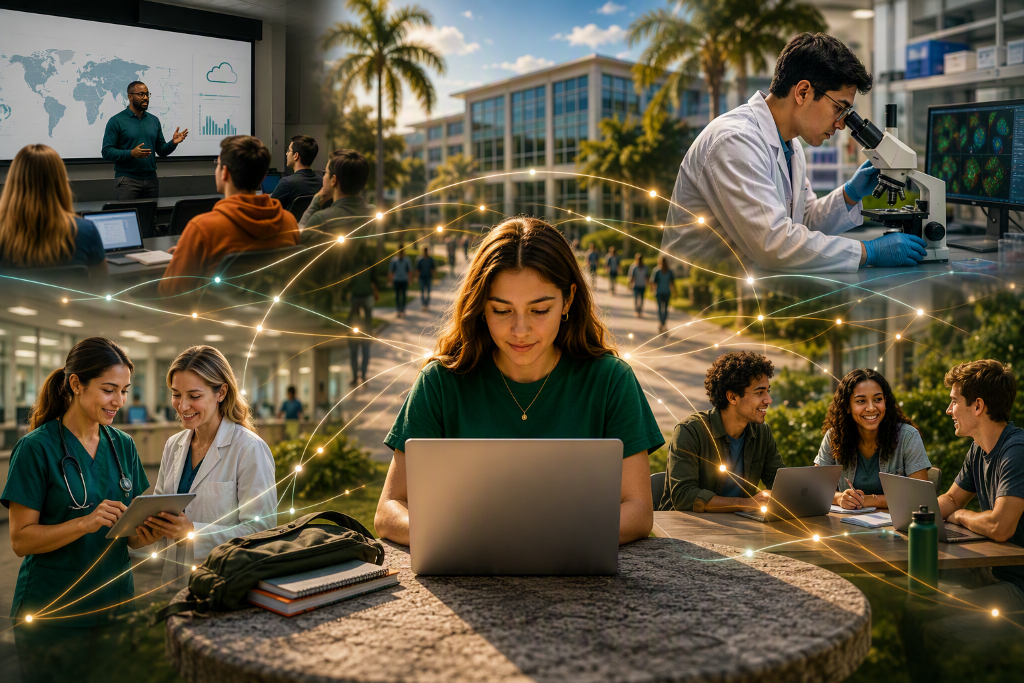
There was a time when wireless connectivity on a university campus was considered a convenience—a nice-to-have. Today, it is as fundamental to the University of Miami experience as electricity, running water, or climate control.
Students expect to open their laptop and immediately begin learning. Researchers expect uninterrupted access to the resources driving discovery. Clinicians rely on mobile technology to support patient care. Faculty teach in increasingly digital classrooms, and staff depend on seamless connectivity to keep the University moving.
Connectivity is no longer a luxury. It is infrastructure.
Where We've Been
The way we think about connectivity at the University has changed as dramatically as the technology that powers it.
Years ago, wireless networks were designed around a very different reality. A classroom might have supported a handful of laptops. Residence halls saw relatively few connected devices. Mobile applications were limited, video conferencing was uncommon, and cloud-based collaboration had yet to become the norm.
As expectations evolved, our infrastructure had to evolve alongside them.
Over the past several years, the Information Technology & Systems (ITS) team has undertaken a fundamental transformation of the University's wireless environment—not simply by replacing hardware, but by rethinking how connectivity should be designed, deployed, and experienced.
That evolution ultimately led to the creation of the Network Experience & Access Services (NExAS) initiative—a shift in philosophy that recognizes connectivity as more than simply getting a device online. It is about the entire experience: how intuitive it is to connect, how reliable it remains under pressure, how secure it is behind the scenes, and ultimately, how invisible the technology becomes to those who rely on it.
Our objective is not simply to build better networks. It is to fundamentally redefine what connectivity means at the University of Miami by challenging decades of conventional thinking and replacing it with a philosophy centered on experience.
We no longer measure success by asking, "Can users connect?"
Instead, we ask, "How does it feel to use our network?"
That simple shift in perspective has become the foundation of everything we do. It influences every deployment, every design standard, every architectural decision, and every investment we make. When connectivity is engineered around the user experience, technology quietly fades into the background—allowing our students, faculty, researchers, clinicians, and staff to focus on what matters most.
Everything we've accomplished—and everything still ahead—is guided by that simple principle.
Technology should never be the focus. The experience should be. That is the philosophy behind NExAS, and what we believe is the future of connectivity at the University of Miami.
Building a Better Foundation
Modernizing a wireless network isn't as simple as installing new access points.
Every successful deployment begins long before equipment is mounted to a ceiling. It starts by understanding how people use a space—how they move through it, how many devices they carry, what applications they depend on, and what experience they should expect the moment they connect.
That philosophy has fundamentally changed how we design our network.
Over the past several years, we have refined wireless design standards across the University by standardizing deployment methodologies, optimizing antenna selection and radio performance, improving channel utilization, and engineering every environment around the people who use it rather than simply the buildings they occupy.
The result is a network that is more resilient, more predictable, and better equipped to support the University's ever-growing reliance on digital technology.
We've expanded and modernized wireless coverage across academic buildings, medical facilities, research spaces, residence halls, outdoor gathering areas, athletic venues, and student environments—while continuously improving reliability in some of the University's most demanding, high-density locations.
These improvements have been made possible through an ongoing commitment from University leadership, whose continued investment each year reflects a shared understanding that connectivity is no longer an amenity—it's an essential service supporting every aspect of the University's mission.
That investment is experienced every day by students attending class, faculty delivering instruction, researchers advancing discovery, clinicians providing patient care, staff supporting operations, and visitors connecting across our campuses.
Embracing the Next Generation
Innovation doesn't happen by standing still.
One of the most significant milestones in our journey has been the deployment of Wi-Fi 6E across the University.
Wi-Fi 6E expands wireless communication into the newly available 6 GHz spectrum, providing dramatically more available bandwidth, reduced interference, and significantly improved performance in high-density environments where thousands of devices compete for wireless resources.
At the same time, we expanded the University's usable 5 GHz spectrum by enabling channels that had previously gone unused, increasing overall network capacity and reducing congestion throughout the environment.
These changes represent far more than faster speeds.
They create a network that is more responsive, more consistent, and better prepared for the modern demands of teaching, learning, research, healthcare, and collaboration.
Just as importantly, we've continued refining the standards behind the technology itself—from radio optimization and deployment consistency to proactive monitoring and continuous performance improvements.
Whether attending a lecture, collaborating on groundbreaking research, participating in a telehealth appointment, or celebrating commencement with family and friends, our goal remains the same:
The network should simply work.
Where We're Going
Technology never stands still—and neither do we. Our roadmap extends well beyond today's wireless network.
We're simplifying how users connect by reducing unnecessary complexity while strengthening security behind the scenes. We're expanding coverage into underserved spaces, continuing to modernize aging infrastructure, and investing in technologies that allow us to understand the user experience long before someone submits a support request.
We're exploring artificial intelligence (AI)-assisted analytics, proactive experience monitoring, next-generation wireless standards, and new ways to measure success that focus not just on infrastructure health, but on the people who rely on it every day.
For decades, enterprise networking has measured success through metrics like uptime, utilization, and signal strength. Those measurements still matter. But they no longer tell the whole story.
Success is measured by whether students can focus on learning instead of troubleshooting.
Whether faculty can walk into a classroom knowing technology will support their lesson.
Whether clinicians can access information when every second matters.
Whether researchers can collaborate without interruption.
Whether staff can simply do their jobs without technology becoming an obstacle.
The best network is the one you never have to think about.
That is the future we're building—not simply a faster wireless network, but a University of Miami where technology quietly empowers every lecture, every discovery, every patient interaction, every collaboration, and every moment that matters.